One of the most foundational decisions when starting any knitting project is selecting the correct tools. Specifically, understanding knitting needle sizes is paramount for achieving the desired gauge and overall look of your finished piece. The right needle size works in harmony with your chosen yarn to create fabric with the correct drape, density, and texture as specified by your pattern. Using needles that are too large or too small can drastically alter the outcome, leading to fabric that is either too loose and floppy or too stiff and dense. Therefore, mastering this aspect is crucial for every knitter.
Deciphering Knitting Needle Sizes and Their Impact
Knitting needle sizes are typically indicated by a number. However, this number varies depending on the sizing system used, such as US, metric, or UK/Canadian. Most patterns will specify a metric size (e.g., 4.0mm) and often include a corresponding US size (e.g., US 6). It’s crucial to pay attention to both, but metric measurements are generally the most consistent globally. Larger numbers (in metric) indicate thicker needles, which consequently produce looser stitches and a more open fabric. Conversely, smaller numbers indicate thinner needles, resulting in tighter stitches and a denser fabric. The material of your needles, whether wood, metal, or bamboo, can also subtly affect your gauge, as some materials provide more grip than others. This variation is important to consider.
How to Choose the Right Needle for Your Yarn and Project
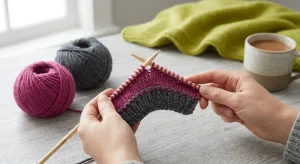
Your yarn label is your first and best resource when choosing knitting needle sizes. Most yarn manufacturers recommend a range of needle sizes that work best with their specific yarn weight. For example, a worsted weight yarn might suggest 4.5mm-5.5mm needles. Always start with the recommended size and knit a swatch. A swatch is a small sample of your knitting that allows you to check your gauge (the number of stitches and rows per inch). If your swatch is too small (too many stitches per inch), go up a needle size. If it’s too large (too few stitches per inch), go down a needle size. This simple step ensures your finished project will match the pattern’s dimensions and desired look. Furthermore, this practice saves you time and frustration in the long run.
Understanding Different Sizing Systems for Knitting Needles
As mentioned, knitting needle sizes aren’t universally standardized by a single numbering system. This can be a source of confusion for new knitters. Primarily, there are three main systems: metric, US, and UK/Canadian. Metric sizes are straightforward, directly referring to the diameter of the needle in millimeters (mm). For instance, a 4.0mm needle is exactly 4 millimeters in diameter. This system is widely considered the most reliable and is increasingly adopted globally. In contrast, the US numbering system uses arbitrary numbers that don’t directly correlate to a physical measurement. A US Size 6, for example, corresponds to approximately 4.0mm. Similarly, the UK/Canadian system also uses its own set of numbers, where larger numbers often indicate smaller needles, which can be particularly confusing. Therefore, always double-check your pattern for the specified system and corresponding metric equivalent. Many patterns for knitting patterns will provide conversions, helping you select the correct tools.
The Importance of Gauge Swatching
Gauge swatching is arguably the most critical step in ensuring your project’s success. It’s a small, square sample of knitting worked in the pattern’s specified stitch (or stockinette if not specified) using the recommended yarn and needle size. The purpose is to determine how many stitches and rows you get per inch or centimeter. Your personal tension, which is how tightly or loosely you knit, will invariably differ from the pattern designer’s. Consequently, even if you use the exact recommended knitting needle sizes, your gauge might be off. If your swatch has too many stitches per inch, your fabric is too dense, and your finished item will be smaller than intended. You should therefore switch to a larger needle size. Conversely, if your swatch has too few stitches per inch, your fabric is too loose, and your item will be larger. In this case, you need to use smaller needles. This simple yet effective technique ensures your finished garment fits and drapes as intended. Moreover, it prevents wasted time and yarn on a project that doesn’t meet expectations.
Factors Beyond Size: Material and Type of Knitting Needles
While the actual diameter is paramount, the material and type of your knitting tools also play a significant role. Knitting needles come in various materials, each offering a unique knitting experience. Metal needles, often made from aluminum or nickel-plated brass, are smooth and slick, allowing stitches to glide quickly. This can be advantageous for experienced knitters or those working with sticky yarns. However, for beginners, or those using very slippery yarns, the speed might lead to dropped stitches. Wooden or bamboo needles, on the other hand, offer more grip. This increased friction helps keep stitches on the needles, making them an excellent choice for beginners or for intricate stitch patterns where precision is key. Plastic needles are another option; they are lightweight and flexible, often preferred for larger projects or by knitters with hand sensitivities. Additionally, the type of needle – straight, circular, or double-pointed – impacts your project. Circular needles are incredibly versatile for knitting in the round or for large flat pieces, while double-pointed needles are essential for small circumference knitting. Therefore, choosing the right knitting needles involves more than just size; it’s about matching the tool to your comfort and project requirements. You can learn more about types of knitting needles from external resources.
When to Deviate from Recommended Knitting Needle Sizes
While following the pattern’s recommended knitting needle sizes and performing a gauge swatch is always the best practice, there are instances where you might intentionally deviate. Sometimes, you might want to achieve a different fabric effect. For example, if you desire a lacier, more open fabric with a particular yarn, you might intentionally go up one or two needle sizes from what’s recommended. This creates a looser drape and larger stitches. Conversely, if you want a denser, stiffer fabric, perhaps for a bag or a sturdy toy, you might go down a needle size or two. This results in a tighter, more compact knit. Experienced knitters often experiment with different needle sizes to achieve unique textures and aesthetics. Furthermore, personal preference plays a role; some knitters naturally knit tighter or looser than average, and adjusting needle size becomes a personal calibration. It’s important to remember that any significant deviation will alter the finished dimensions of your project, so careful consideration and swatching are still advised. For example, when making a garment, precise sizing is often crucial, so adjustments should be made cautiously. Knowing how to adjust your knitting needle size effectively is a valuable skill.
Troubleshooting Common Needle Size Issues
Even with careful planning, you might encounter issues related to knitting needle sizes. One common problem is a project that ends up significantly larger or smaller than expected, even after swatching. This can happen if your tension changes as you knit, perhaps due to fatigue or a change in your knitting environment. Another issue is an uneven fabric, where some sections are tighter or looser than others. This often points to inconsistent tension rather than an incorrect needle size. If your stitches are constantly slipping off your needles, they might be too slick for your yarn, or the size might be too small for the yarn weight, causing too much tension. Conversely, if your stitches feel too tight and difficult to move, your needles might be too large for the yarn, or your tension is excessively tight. Remember, these are common challenges, and with practice, you’ll learn to recognize and address them. Often, a quick check of your technique or a small adjustment to your tools can resolve the problem. For instance, if you are struggling with stitch definition, exploring various knitting stitches might also help.
Exploring Different Types of Knitting Needles
Beyond material, the form of knitting needles significantly impacts the projects you can undertake. Straight needles are the traditional choice, typically used for flat projects like scarves, dishcloths, or flat panels of garments. They come in pairs, with a stopper at one end to prevent stitches from slipping off. Circular needles are incredibly versatile, featuring two needle tips connected by a flexible cable. They are ideal for knitting in the round, such as for hats, sweaters, or socks, but can also be used for large flat projects where straight needles would be cumbersome due to the number of stitches. Double-pointed needles (DPNs) are short, straight needles with points on both ends, usually sold in sets of four or five. They are perfect for small circumference knitting in the round, like sleeves, socks, or amigurumi. Each type serves a specific purpose, and understanding their applications will broaden your knitting horizons. For many projects, having a good set of various knitting needles is essential.
Maintaining and Storing Your Knitting Needles
Proper care and storage of your knitting needles will prolong their life and keep them in excellent condition. Metal needles can be wiped clean with a soft cloth. Wooden and bamboo needles should be kept away from excessive moisture or extreme temperatures to prevent warping or cracking. Avoid leaving any needles in direct sunlight for extended periods. When not in use, store your needles in a case or organizer. This not only keeps them tidy but also prevents them from getting bent, scratched, or lost. Many knitters use needle rolls, pouches, or even dedicated boxes for storage. Keeping your knitting needle sizes organized, perhaps by type or metric measurement, will also make it much easier to find the right tool for your next project. A well-maintained collection ensures you always have the perfect tool at hand.
Choosing the right knitting needle sizes is a skill that improves with practice and understanding. By paying attention to yarn recommendations, consistently swatching for gauge, and considering the material and type of your needles, you’ll ensure your projects turn out beautifully every time. Don’t skip the swatch – it’s your best friend in achieving knitting success. Ultimately, confidence in selecting the right tools will enhance your enjoyment of the craft and the quality of your finished pieces. Happy knitting!
FAQ: Answering Your Common Questions About Knitting Tools
What are the different sizing systems for knitting tools?
There are three primary sizing systems for knitting tools: metric (millimeters), US (arbitrary numbers), and UK/Canadian (also arbitrary numbers). Metric is generally the most consistent and widely adopted worldwide, with numbers directly corresponding to the needle’s diameter.
Why is it important to check my gauge?
Checking your gauge with a swatch ensures your finished project will match the dimensions and drape specified in your pattern. Your personal knitting tension can vary, so swatching helps you adjust your needle selection to achieve the correct number of stitches and rows per inch.
Can I use a different size needle than recommended in a pattern?
Yes, you can intentionally use a different size needle to achieve a different fabric effect. For example, a larger needle creates a looser, lacier fabric, while a smaller needle results in a denser, stiffer fabric. However, always remember this will alter the finished project’s dimensions.
How do needle materials affect my knitting?
Needle materials like metal, wood, bamboo, or plastic affect how stitches glide. Metal needles are slick, offering speed, while wood or bamboo provides more grip, which is helpful for beginners or slippery yarns. Plastic needles are lightweight and flexible.
What are circular needles used for?
Circular needles are highly versatile. They are primarily used for knitting in the round, like for hats, sweaters, or socks. Additionally, they are excellent for large flat projects where the weight of many stitches would be cumbersome on straight needles.
How do I know if my needles are too big or too small?
If your fabric is too loose, floppy, and has too few stitches per inch on your swatch, your needles are likely too large. Conversely, if your fabric is too stiff, dense, and has too many stitches per inch, your needles are probably too small. Adjust accordingly after swatching.