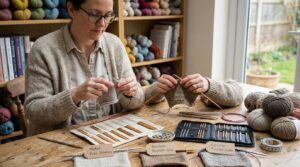
Have you ever admired a beautifully patterned sweater or a vibrant pair of mittens and wondered how those intricate designs are created? The secret often lies in colorwork knitting, a technique that allows you to incorporate multiple yarn colors into your projects. If you’re ready to learn colorwork knitting and add a new dimension to your crafting, you’re in the right place. This comprehensive guide will walk you through the exciting world of Fair Isle and stranded colorwork, making these seemingly complex techniques approachable for any beginner.
Colorwork isn’t just about making pretty patterns; it’s about expanding your creative horizons and adding personality to your handmade items. From cozy hats to stunning garments, mastering color knitting techniques opens up a universe of design possibilities. Let’s grab our needles and dive into making some magic!
What is Colorwork Knitting?
At its heart, colorwork knitting involves working with two or more colors of yarn in a single row or round to create patterns. The most common forms are stranded colorwork and Fair Isle, often used interchangeably. However, Fair Isle is a specific type of stranded knitting originating from the Shetland Islands.
Stranded Colorwork vs. Fair Isle
Stranded colorwork is the general term for any knitting where you carry unused colors across the back of your work. These are called ‘floats’. You pick up the color you need for each stitch and drop the one you don’t, leaving the dropped yarn ‘floating’ behind the active stitches. This technique is fantastic for geometric patterns, motifs, and pictorial designs.
Fair Isle knitting is a specific tradition of stranded colorwork characterized by certain elements. Typically, only two colors are used per row. Colors are changed frequently, and patterns often feature repeating motifs like Xs, Vs, and stars. The floats on the back are usually kept short, adding to the fabric’s warmth and stability.
Essential Supplies for Your First Colorwork Project
Before you begin, gathering the right tools will make your journey into colorwork much smoother. Therefore, careful preparation is key to a successful project.
Yarn Choice Matters
For your first stranded knitting for beginners project, choose yarns that have good ‘stickiness’ or ‘grip.’ Wool is an excellent choice because its fibers tend to cling together, which helps prevent floats from snagging and gives a more even fabric. Avoid superwash wools or slippery fibers like silk or rayon for your initial attempts, as they can be harder to manage.
Select two contrasting colors that are easy to distinguish. A light and a dark color will make it simpler to see your stitches and ensure you’re using the correct yarn. Once you’re comfortable, you can experiment with more subtle color palettes. Consider exploring different yarn options to find what works best for you.
Needles and Notions
Circular needles are generally preferred for stranded colorwork, especially when working in the round, as they allow you to easily manage multiple colors and the tension of your floats. You will need a needle size appropriate for your chosen yarn. A good starting point is usually the size recommended on the yarn label. For more details on choosing the right tools, check out our guide on the best set of knitting needles.
Additionally, you’ll need stitch markers to mark pattern repeats or the beginning of a round. A tapestry needle for weaving in ends is also essential. Small scissors are always handy for cutting yarn. Furthermore, a row counter can be very helpful for keeping track of your progress, particularly in more complex patterns.
Getting Started: Basic Techniques to Learn Colorwork Knitting
Now that you have your supplies, let’s explore the fundamental techniques you’ll need. These steps will help you successfully learn colorwork knitting and create beautiful designs.
Holding Your Yarns
There are several ways to hold two colors of yarn simultaneously. The most common methods are: holding both yarns in your left hand (Continental style), holding both in your right hand (English style), or holding one in each hand (one Continental, one English). Experiment with each method to find what feels most comfortable and gives you the most consistent tension. For instance, many knitters find holding one color in each hand provides excellent control.
- Both yarns in left hand: This is common for Continental knitters. You can wrap one color over your index finger and the other over your middle finger.
- Both yarns in right hand: English knitters might hold both strands over their index finger, carefully separating them to pick up the correct color.
- One in each hand: This method is often called